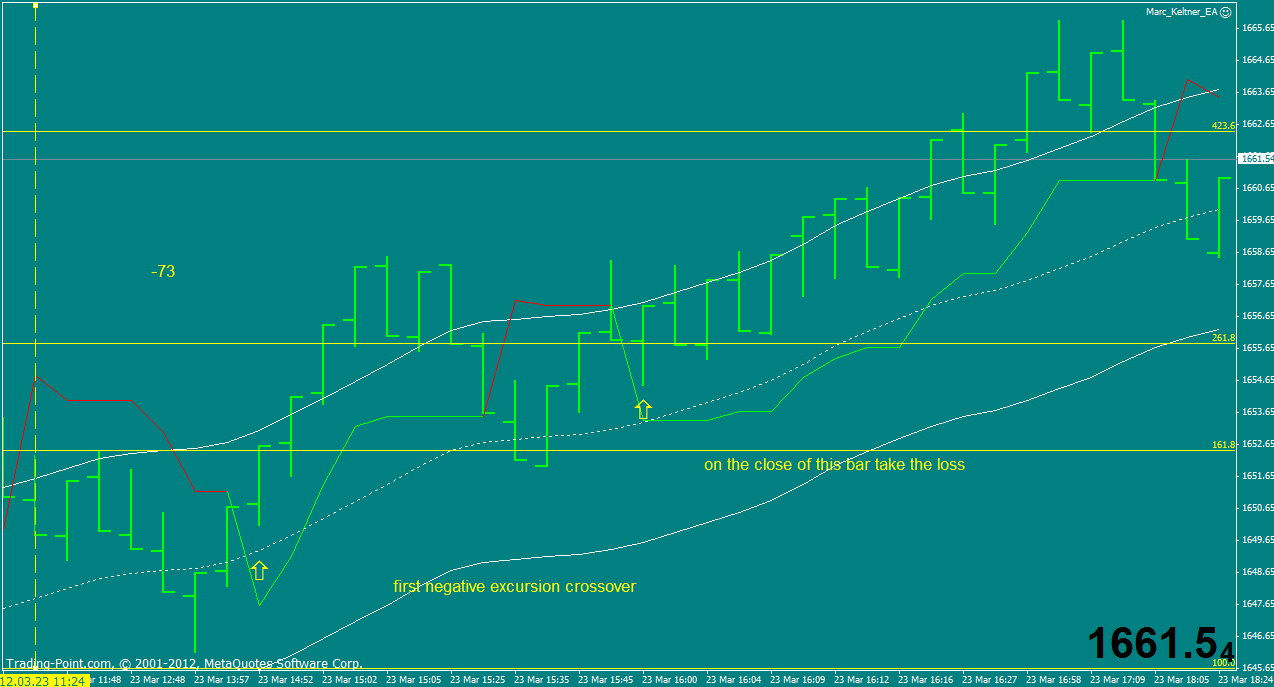
So I asked myself, what is it about Meantrades that makes volatility a necessary and good thing? The answer surprised me a little, and makes me doubt what I discovered as it seems I am on to something that most retail traders are unaware of. And how can that be? I'm just a regular guy who happens to be a forex trader.
Volatility is a measure of uncertainty.
Meantrades signals are determined when a reversal is seen short term on a longer trend. For example, if the daily trend is long, Meantrades will only see a buy signal if there is a swift selloff and rapid reversal. The amount of time necessary for this reversal is usually around 12-48 hours, anything longer and the daily trend is at risk of reversing and this prevents signals on smaller time frames to fail to appear. I should mention then, that the past few years I have traded nothing smaller than an hourly chart (and the range bar equivalent).
But, what exactly is being measured in Forex volatility?
The term is often used interchangeably with acceleration and range. But, what is truly important from my perspective, is that it refers to uncertain direction in the market with an expanding price range (this requires an objective assessment which traders demarcate with options trading, most commonly used for commercial hedging rather than outright speculation). All other meanings are interesting but not very relevant for my needs as a directional trader.
I think it is worth delving into popular standard definitions as most people simply have an emotional or experiential reaction to the news of "volatility" in the markets. I too was vulnerable to this for years as I was glued to CNBC and then Bloomberg on the tv in the background. I've since gone dark and rarely, if ever, turn on the news when i am trading. I have even extended this to popular forums and chat rooms where trade signals are issued. I find that no matter how useful the information, it will eventually conflict with my own signals. Inevitably the signals I choose to ignore because of external information will be the screaming winners.
Investopedia defines volatility as either:
1)A statistical measure of the dispersion of returns for a given security or market index.
Or:
2)A variable in option pricing formulas showing the extent to which the return of the underlying asset will fluctuate between now and the option's expiration.
The point is the press almost never refers to either of these definitions when they report on volatile markets. All the are reporting on is that a closely watched index has dropped a larger percentage than in previous sessions. In itself this is of course, important and newsworthy, but for traders it creates false assumptions.
Why do bloggers often talk about the dangers of volatility in trading?
Simple. Most trading systems are static in their application. They do not seek a dynamic pattern to determine entries and exits. Although meantrades uses no "feel"or artificial intelligence. It seeks a "nesting" pattern which only works well when volatility is present in the forex market. Perhaps this is the main differentiation between Meantrades and systems such as these. There have been popular systems over the years which attempt to tackle this but often their complexity extends far beyond the capacities of retail traders. Which frankly is a nice thought exercise but without vast economic resources, they are just not satisfactory solutions for the average trader. The buzzword associated with these "revolutionary" systems is: adaptive. Two of the more interesting are well presented in video format:
Summers Bars are very similar to constant range bars. However they perform one extra adaptive function which really caught my eye. They take into account the average volume in previous bars and begin to print as volatility increases. This smooths out indicators as well as gives you a unique technical perspective which standard charts cannot offer. The results are not necessarily an improvement but, like meantrades, it puts you in and takes you out of the market in less crowded junctures.
Adaptive Moving Averages were popularized by Perry Kaufman. According to Investopedia this approach would:
allow winners to run. As a trend comes to an end and prices consolidate, the moving average would move closer to the current market action and, in theory, allow the trader to keep most of the gains captured during the trend.
However just as static approaches to markets have proven, this very interesting attempt was nothing more in the end than intellectual stimulus for whipsawed traders everywhere. As the article mentions in conclusion from a great book on backtested technical indicators:
"Although the adaptive moving average is an interesting newer idea with considerable intellectual appeal, our preliminary tests fail to show any real practical advantage to this more complex trend smoothing method."
Volatility, the most dynamic of indicators.
Trading static systems in a dynamic market will yield excellent results some of the time, and dreadful results the rest of the time. Using a crass simplification, mean reversion trading will yield tiny gains 70 percent of the time while breakout systems will get chopped to death during the same market conditions. While breakout systems will reap huge rewards during the other 30 percent of the time while mean reversion systems will lose all their gains in the same market environment. I have seen some try to create a barometer to transfer between each method with fairly effective results, and for this I think they alone get how retail trading is done. For the rest, there is just heartache without much education other than to learn how to admit defeat in the face of an unflinching forex market.
The trick for most traders is to learn to embrace volatility, not as a dangerous side effect but as a surfer would; acknowledge the force of nature which provides you with the waves to surf. It's best o remember that nobody ever got rich in a still marketplace.