Sunday, March 25, 2012

Negative excursion volatility based stops

Over the past few months I have begun to employ more and more traditional price based stops. The beginning of this year found meantrades reaching into drawdowns which I was not that comfortable trading with. Taking hard stops and walking away for the day is tough in any system but when applying it to a mean reversion system it means you are inevitably getting stopped out just before the market turns.

Since employing supertrend volatility metrics I realized that there is a remarkably consistent pattern occuring between price action and the ATR based indicator popularly known as supertrend. When the market reverses and the signal is created in the meantrades system very often if the market does not take off in the expected direction it will pasue for a while and then resume the expected direction. However if it doesn't it will accelerate resuming the trend creating a negative excursion for meantrades. This is ok, I have always dealt with this and will continue to do so. But the beauty of supertrend is that it allows you a chance to observe price action and its commitment for continuation or mean reversion.

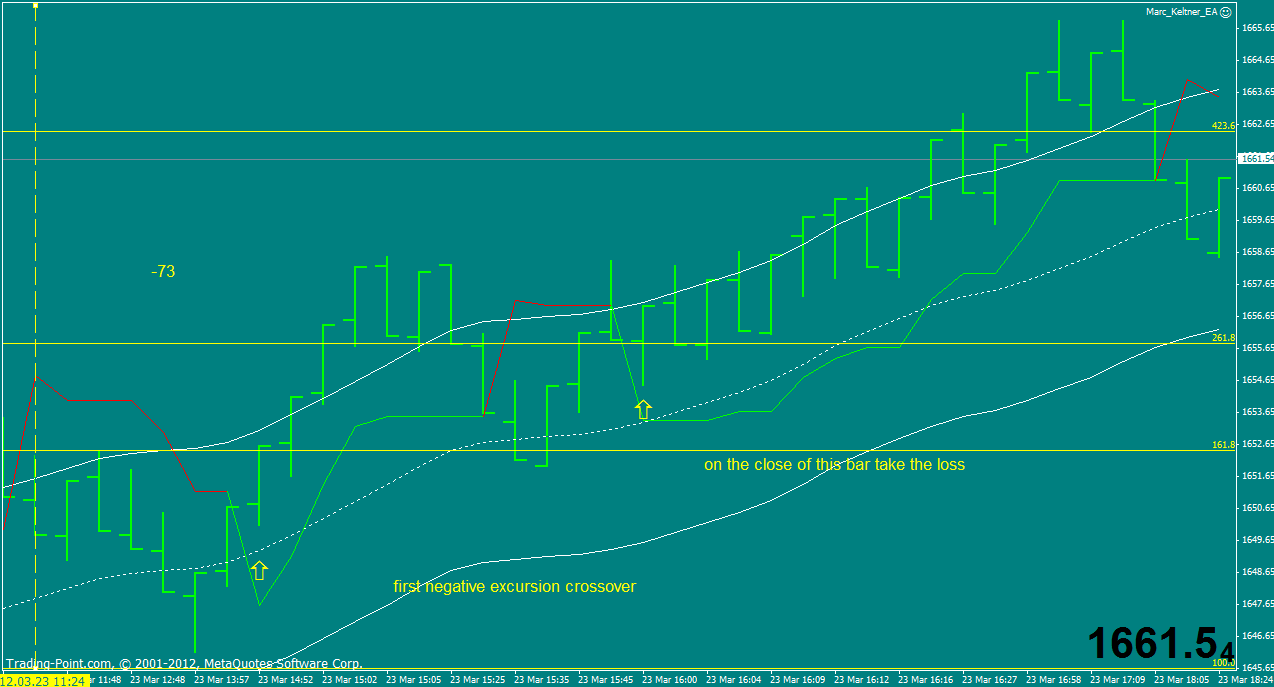
So I'm adjusting my stop method slightly again. Instead of taking the swing high or low I will employ the  supertrend crossover on its second negative excursion.

You can see in the screenshot below that a signal was generated at 11:24 and then the market resumed its uptrend. Once more the market began to revert to its mean however it could not reverse as anticipated so a stop was taken on the second supertrend crossover to the upside. Notice that the stop taken is actually lower than the swing high--where we have been taking stops for the past few months.


This stop method does have an unpleasant downside. You cannot know exactly where you will stop out before you enter the trade. However taking the observations of legendary traders who have come before me as dogma, it has been said time and time again, markets revert to their mean, even on a fractal level and thus for every larger stop painfully absorbed, there will be many smaller stops which create more meantrades alpha in a longer data set. Markets will always seek the most viscous point to move towards in order to damn the largest amount of traders in the market. By employing a volatility based stop which assumes markets will revert on every level of price action, stops should see a positive reduction in end of day balance draw-downs. However this means intraday account balances will almost certainly increase.

Employing this stop revision, results from the 3rd week in March have been encouraging.

EUR 3/19-3/23: +160
GBP 3/19-3/23: +47
XAU 3/19-3/23: +184 (this includes the stop posted above on Friday's trade)

Sunday, January 29, 2012

Meantrades in a slump; What would Jesus do?

As is usually the case, a trading system goes through periods of immaculate fluidity where almost every signal follows the market precisely. Meantrades had several months last year where profits became so much the norm that I briefly began to think it could be automated due to its steady ability to produce consistent and robust profits. Well, the past two months have put a real damper on my confidence in that regard. Granted, meantrades has, historically, never been very good in December and January. This year however, it's just worthless. There have been periods of more than 3 trading days where not a single currency pair I trade has produced break even results. Normally meantrades is very good at capturing ranging markets and occasionally a few reversal trades which turn into huge winners. This is the secret sauce to meantrades. It needs a few huge winners each month to make it truly profitable. Without that expectation, there is no reason to "blindly" take its signals. Expectancy is the Jesus factor.

Without faith there can be no commitment to the system. Once this is the case we are back to speculation and playing with randomness. Not a happy place for an independent retail trader to be.

So, where to go from here? Scale back. Trade smaller size and wait for the markets to come to me. No reason to think that there has been some fundamental shift in the pricing behavior of intraday markets. Perhaps contraction of overnight volatility paired with anemic global trade has taken many of the pricing spikes out of the market. I'm not an economist and I don't work at a bank but there is no reason to toss a system which has performed so well in the past just because of a few unprofitable weeks (no matter how painful that experience can be).

I will however keep trading my intraday trend system running to keep some balance in the portfolio. The trend system has performed quite respectably. Most days it can take a quick 30 pips from the market. Not always, that's why I have not completely abandoned meantrades in the past. The polar opposite approach of reversion to the mean trading is probably not trend trading but the two strategies complement each other with delightful symmetry.

A rare profitable day for meantrades on Friday, +59 before the NY open.

Markets seem to be headed into choppy waters for the foreseeable future I am prepared for the inevitability of contracting equity curves. Wish you the best in your own mechanical system equity journey.

Thursday, January 5, 2012

Goals for the coming year

With a new year comes renewed enthusiasm for my trading. I anticipate this will be my breakout year where I finally break the nut which has proved so elusive: consistent trading profits.


My first primary goal is consistency. I intend to trade 2 systems on the forex and spot gold markets.

The first system is meantrades classic. Depending on the prior months results I will either use 10 range or 20 range bars to maximize profitability.

The second system is a momentum based system which does not use support and resistance levels. A pure trend trade system which will test my patience as well as my beliefs about the forex market.

Another goal very much on my mind is the use of stops. Last year I discovered that the best thing about constant range bars was not their clarity of trend but their ability to reduce stops to the smallest level possible (but not any smaller). Thus my goal is to apply stops on a absolute dogmatic level.

In the past few months I have discoevred the world of online poker and have experienced some modest success. The exercise of playing another game of skill with money has helped me realize just how essential stops are in the longevity of a trading system. For years I struggled with this. Meantrades did not employ price stops and although the returns were outstanding, in other periods the draw downs were just unbearable.

On the mental side of things my goal is to not respond so emotionally to situations I find uncomfortable. Just try and take things in stride. I'm 36 years old, it's time to find some peace of mind in my life experiences. Some things in life are just unpleasant. Better to face them head on than the rant and rave about how distasteful they are.

Hope the New Year is a good one for you too.

Good trading

Saturday, December 3, 2011

Nesting

There are quirks to each persons trading which create undefinable edges. In my case I think there is a very subtle pattern in the signals created from meantrades setups. I define this as nesting.

No, not a birds nest. Although a tasty and very expensive Asian delicacy, it is not what I am referring to.


When I think of a meantrades setup, the idea of a coiled spring comes to mind. The idea of a rapidly expanded spring which snaps into action and has no control is a beautiful image once I am in a trade, as long as the spring is heading in its intended direction of course.

Specifically the nested signal is when price violates a keltner band and then returns for a reversal setup, however it has not yet closed below the median keltner line (which is actually just a 20 period sma). This type of setup has always appealed to me a very deep level but I never understood why.

After some consideration I realize now it creates a very subtle edge in my signals. It allows the signal to be created as close to the swing high level as possible.

Take two hypothetical signal examples from the meantrades setup, one with a nesting price point and one without.


As you can see from the first scenario, the ideal stop level is further away than preferred. By taking a trade without a nested price bar between the outer keltner band and median line, risk is increased. Over time this will eat away at profits and create doubt about the system, we want to avoid this at all costs. Even though you can easily scan through the charts and find quite a few huge winning trades which did not nest, it is the risk tolerance of each account which should be kept in mind first and foremost.


In the second photo we see an ideal nesting scenario, price retraces, tests the lows and then carries higher to successful target completion. Trades like this are why I am so confident in the potential for meantrades to remain robust and kind well into the future. All you need is momentum and retracements and the profits will come consistently week after week.


Wednesday, November 23, 2011

Meantrades Exit Strategies; taking huge swings with zero risk

In the past few years I have observed some of the debates which spring up regarding how to take a profit in intraday trading. There are 2 basic strategies.


  1. Take profits at a pre-determined level and go flat.
  2. Exit half a position at a predetermined level and move stop to break-even (or break-even plus enough to cover commissions).
There might be a slightly better way to achieve ideal profitability. It will require that you know the strengths and weaknesses of your system.

With regards to meantrades, there are two basic exit strategies when combined, are quite effective at maximizing profits.

The two basic techniques are as follows:

  1. When price reaches the opposite keltner band from entry, we can take our profits, go flat entirely.
  2. When price reaches the opposite keltner band from entry, we can move our stop to break even and begin using the supertrend stop as our trailing exit. 
The second option creates far more profits but it is not a smooth process. Perhaps 70% of all trades will be stopped out for zero gains. That's not an easy way to trade intra-day and can lead to overriding the rules of the system.

One solution to this is to work with a very rudimentary wave structure to determine which exit method to use.

One of the more effective structures is a double top or a double bottom. When taking the initial topping short trade take the keltner touch as the profit exit. However if price trades back up to the original top area and either stops you out for a loss and creates a fresh signal OR price simply tests the top, the second touch of keltner should be considered an opportunity to trail the trade and shoot for the moon.

Here is an example of the double top trade scenario:


As you can see the second short trade went much further and allowed us to benefit in several ways. By already having a nice profit for the day we could take our chances on a huge run with our stop at break even. This is what we should always strive for: take huge chances with zero risk.


A second technique, which I am toying with is to use a uniform exit strategy until the weekly target objective is met and then to switch over to the opposite one. In other words, if your goal is 100 pips a week and you started off the week using supertrend exits, once you reached the 100 pips you would then switch over to keltner exits for the remaining trades for that week. This allows you to trade with much less indecision and fear that you will miss potential profits. 

Something else in the back of my mind, although not yet tested, is to take some average of the MPE (Maximum Positive Excursion) and use that as the absolute exit for trades. I never really thought this was an ideal method to exit as it does not adjust according to volatility the same way that the Keltner bands do but I still remain curious as to the relative performance of applying keltner exits versus fixed exits. In order to create this exit strategy I would need to record the MPE as well as the MAE (Maximum Adverse Excursion) in my trade journal (which I don't do at the moment.)


Sunday, November 20, 2011

OHLC is just a line in the sand for Support and Resistance

In spite of my interest in OHLC, there are plenty of other ways to create very clear and potent daily levels of support and resistance within the meantrades method.

Let's compare several of them and see the results from last week.

Using 10 pip CRB's we can track the progress of each method of Support and Resistance. It's starting to become fairly obvious that no matter how to create your "line in the sand" on your chart, every day the results will vary. Thus, for posterity's sake, let's compare the results. Keep in mind when we look at historical trades, we are very mechanical in our entry, although in real-time you can be less so, taking into account the velocity of the markets (the rate of bar change) to help you decide if one of the primary rules of meantrade could be overlooked for the sake of a great risk to reward setup. For example, perhaps price has already violated the keltner midpoint and you still want to take the reversal from the S/R level. There are so many good trades which don't set up perfectly. This requires a traders vision and resourcefulness and is the reason most great mechanical systems cannot be hardcoded into a black box to ride off into the sunset and make us all millionaires in a month.

Traditional Pivot points (using the daily close at 5pm as the starting point for daily calculation):


11/14-11/19, Keltner touch exit: +30
11/14-11/19, Supertrend exit (note: when using the supertrend exit, we move stops to break even once we touch the opposite keltner band from entry, it creates a high percentage of break even stop outs, but allows for a few really big wins throughout the trading week): +31

Fibonacci Levels based on the first High Low close of the day:
(One of the true benefits of this method of creating intra-day S/R is that it does not have levels after the market breaks out, in a sense, it only looks for reversals within the expected daily range)
11/14-11/19, keltner touch exit: -28
11/14-11/19, supertrend exit: +102

With this method we also have the option of trading with the trend only after price has broken the last fib extension level. As you can see in the screenshot above, this creates some very high probability setups.


ORB Fib levels based on Asian session range:
11/14-11/19, keltner touch exit: +87
11/14-11/19, supertrend exit: +114


Finally, OHLC levels:

11/14-11/19, keltner touch exit: +51
11/14-11/19, supertrend exit: +114

Quite interesting that the OHLC S/R levels performed exactly the same as the ORB Fib levels. Fine with me, it proves Meantrades was ok the way it is originally. I like having that validation. Most people in back-testing circles refer to that mental condition as positive expectancy. With positive expectancy we can take every signal without trepidation.

One more method for creating S/R levels I learned from a guy on elite trader a long time ago who claimed, with about 5 years of trading futures under his belt by this time, that if you adjusted your fib ratios to 3.77, 5.12 and 7.80 instead of the standard, 1.618, 2.618 and 4.236, you would have more accurate targets for the daily range. I tested it a while back and it was true...sometimes!

If we take the opening range and use these ratios, as well as high low and 50% of the ORB and then applied these ratios for last weeks trading this is what happens:

11/14-11/19, keltner touch exit: +113
11/14-11/19, supertrend exit: +206

Looks like a winner.


Keep in mind that this is based on a single brokers data. Your results will certainly vary. In fact, I invite anyone to get in touch with me on yahoo at "mezarashii" and I would be happy to teach you how to set up your charts to get you going on meantrades..., well, I'm not sure what we should call the last method of creating S/R levels. I'm open for suggestions.

So what did I discover here in the end. Almost certainly pivots are a waste of time when trading horizontal support and resistance levels. But then, this I knew for years. I'm not sure why it does not work in forex but I'm assuming it has a lot to do from what time you plot them and the end of trading for one market is not the end for another. Perhaps re-plotting based on the opening price of each market would yield more active S/R lines but at this point I will leave that discovery to someone else. I prefer ratios and you can see why with the results from last week. Imagine getting a yield like that week in and week out. Most of these winning trades came on 2 or 3 days only. The beginning of the week was a real dud and sitting on a negative balance was quite challenging. But with positive expectancy, you can continue to pull the trigger with total confidence. That is what I took from this weekend analysis.


Wednesday, November 16, 2011

Meantrades OHLC a deeper understanding...


My objective with altering the Support and Resistance levels to OHLC with Meantrades is to refine an already useful concept. The less trade points we have an opportunity to trade, the more likely we are to execute according to plan. Of course the assumed premise is that the system has a positive expectancy.

Meantrades, regardless of how the support and resistance lines are formed, no matter what the time frame, has a positive expectancy. The only question in my mind has always been drawdowns. OHLC seems to create a more significant way to enter the market and reduce risk.

Yesterday there was 3 trades in 4 markets I follow. EURUSD went for a loss, Oil had a break even stop, as did YM index. With intervention both Oil went for 40 points as did the YM. The EURUSD loss was -37 pips. In the previous stop method of meantrades, the EURUSD trade would still be short and sitting on a drawdown of about 150 pips this morning. Nothing to panic about, but with volatility at an all time high, there will come a day in the not too distant future where the maximum negative excursion will be so large, no account size can handle it. I hate hard stops, but I hate margin calls even more.


OHLC will always be used with modified price bars. Originally I saw the value of constant range bars with their ability to remain in trends longer. These days, it is more about reducing risk. If you were to compare a stop loss on a time based price candle, there is no way to know truly how large it will get before its close. Fast markets create larger candles. With constant range bars, fast candles are always the same size. Compare these two losing trades to see what I mean:

I am using the 15 minute time frame in comparison. There is no exact way to compare the two charts. In my eyes 15 minutes seems to be the smallest time frame you can trade without seeing false signals all over the place. But then, some people see the market crystal clear on 5 minute charts. It doesn't really matter to me anymore, CRBs have eliminated any lack of clarity for me in the markets.


Here we can see with CRBs we reduced the stop loss not only in amount of pips but we were able to see that the market had violated its stop level much earlier than with the conventional time based chart.


To recap what Meantrades actually comprises:


  • Keltner bands: 


We must have a Keltner band touch of the outer band in the opposite direction of the trend. We don't want to be trading support and resistance without a healthy amount of momentum in either direction. If a market is simply climbing the wall of worry, there is no place to be looking for reversals. It is much better to be with the trend at that point as it will eventually climax and present a better reversal trade opportunity at some later point.

2 possible Keltner band setups:


  1. Market has a strong breakout outside the Keltner bands and then reverses.


2. Market trades outside the Keltner but has no thrust higher. This is a slightly lower percentage scenario than #1 but nonetheless still a statistically significant trade setup. Often this trade can turn into a creeping market where it never has any thrust higher but still takes out stops.